Hopelessly under the influence

Wednesday, August 27, 2008

Vicky Cristina Barcelona


Manhattan, with its dramatic black and white images of iconic New York landmarks complete with a Gershwin score, was Woody Allen's love letter to the Big Apple. In press reports he's said that he wanted to do the same thing for Barcelona, and if the golden-tinged cinematography, Gaudi architecture, and Spanish guitar don't resonate quite as deeply, it's probably because the city is an icon that is a little less familiar to America. But that doesn't mean it's not a success.
Initially, I had my doubts about where the film was headed. The voice-over narration, placed sporadically throughout, struck me as unnecessary, and some of the dialogue sounded a bit unnatural: it was articulate but not really conversational. Eventually though, the film seemed to find its rhythm, and turned into an intriguing yet breezy reflection on love and desire.
As always, Woody and casting director Juliet Taylor assemble a strong ensemble. Rebecca Hall (as Vicky) and Scarlett Johansson (as Cristina) compliment each other nicely and are a near perfect contrast in temperament. Cristina is attractive, impulsive, and a romantic, whereas Vicky is elegant but pragmatic. Yet Vicky's development is one of the chief strengths of the film.
There is also the Spanish half of the equation. Javier Bardem, fresh off his dark turn in No Country For Old Men, effortlessly portrays Juan Antonio, an artist and a natural charmer. His ex-wife, Maria Elena (Penelope Cruz), is a passionate though unstable artist seemingly adept at every artistic discipline. Her fiery presence in the film's second half is sure to generate a lot of Oscar buzz.
Somehow, these two American tourists get tangled up emotionally and physically with this Spanish couple, and though their escapades reveal Woody's deeply pragmatic (some would say pessimistic) views on desire, it stops well short of being any sort of morality play. While it carries some of the familiar Allen trademarks (affluent lovers, highbrow interests, urbane locales) it is fresh and lively, having a decidedly European tone, even for Woody. Roger Ebert has, I rightly believe, compared it to some of the works of French director Eric Rohmer.
Ebert also wonders if maybe we've taken Woody Allen for granted. Perhaps we have. This film is just another in a long line of remarkably consistent efforts. It may be under appreciated even by Allen fans who feel this film suffers by comparison to Annie Hall or Crimes & Misdemeanors. But I wonder that if years from now we'll look back and say, maybe with some surprise, "Hey, remember Vicky Cristina Barcelona? You know, that was a really beautiful movie!"

Wednesday, August 20, 2008

The Dark Knight


There's a scene in The Dark Knight where Alfred tells Bruce Wayne a story about a bandit he was trying to catch in Burma many years ago. The bandit stole rubies from a caravan in the forest and then threw them away. He stole, according to Alfred "because it was good sport. Because some men aren't looking for anything logical, like money. They can't be bought, bullied, reasoned or negotiated with. Some men just want to watch the world burn." Bruce then asks how they managed to capture him. Alfred's response: "we burned the forest down."

If there is a superhero that embodies the conflict of our age it is most assuredly Batman, and The Dark Knight is a near perfect cinematic expression of the turmoil in which we find ourselves. Although the problem of dealing with dangerous men is very old, the opportunities they have to wreak destruction have multiplied in recent years. And this latest Batman excursion is an examination of conscience posing as a Hollywood blockbuster.

An enormous amount of credit must go to director Christopher Nolan, whose foray into Gotham has redefined what comic book movies can be. The opening sequence, a taut and deadly bank robbery, calls to mind Stanley Kubrick, and with the rest of the film Nolan poises himself to join the ranks of such elite company. An array of striking shots stick with you: a mountain of cash doused with gasoline and set on fire, the eerie clown masks at the film's beginning, lingering close-ups of faces, and oh yes, the Joker.

Much has been made of Heath Ledger's performance, and, in my opinion, every accolade is justified. The darting tongue, the unnerving laugh and jerky voice, and the anarchic and unexpected bravado leering at you behind a coat of face paint make this Joker one of the most memorable of all movie characters. After seeing his remarkably understated turn in Brokeback Mountain and now this, possibly his greatest role, his death really seems tragic. America has lost one of its best young actors at the height of his powers.

But above all is the specter of Batman lingering in the shadows, contemplating how to fight the chaos of Joker (and later on Two-Face). Gotham is in many ways post 9/11 America and that message is conveyed without being too preachy. The invasion of privacy and the problem of fighting evil with questionable methods resonate strongly in 2008. But these are timeless concerns too, and in a way The Dark Knight returns us to the moral conflict long present in the Batman myth but that has been absent from cinematic adaptations. Can bad means lead to a good end? Does the ruthlessness required to eradicate evil destroy the good in one's self? How just is the vigilante?

It's a curious state of mind that finds you leaving The Dark Knight. Few commercial blockbusters walk such a fine moral tightrope. There is no clear answer to the troubling dilemmas presented. What is offered is the faintest glimmer of hope that good may somehow prevail even as it is chased into a great darkness.

Monday, July 14, 2008

Freaks


The love of beauty is a deep seated urge which dates back to the beginning of civilization. The revulsion with which we view the abnormal, the malformed and the mutilated is the result of long conditioning by our forefathers. The majority of freaks, themselves, are endowed with normal thoughts and emotions. Their lot is truly a heart-breaking one. They are forced into the most unnatural of lives. Therefore, they have built up among themselves a code of ethics to protect them from the barbs of normal people. Their rules are rigidly adhered to and the hurt of one is the hurt of all; the joy of one is the joy of all. The story about to be revealed is a story based on the effect of this code upon their lives (prologue to Freaks).

While waiting for a midnight showing of Eraserhead to begin, an acquaintance of mine told me he had seen Lynch’s avant-garde debut in the late 70’s on a double-bill with another cult-classic: Freaks. Most of the audience were hippie types and were talking and laughing as Freaks began, not knowing what was in store. However, once some of the freaks are first seen, playfully romping in an idyllic clearing, everyone fell silent. For the rest of the movie, he said, you could hear a pin drop.

That Freaks was actually released by a major Hollywood studio in 1932 is astonishing. The reaction to the film was intense and so negative that it was banned in the United Kingdom for thirty years and ruined the career of its’ director Tod Browning.

Hans, a sideshow midget, is seduced by the beautiful trapeze artist Cleopatra once she learns he has come into a large inheritance. Though she marries Hans, she continues her affair with another circus performer, Hercules the Strongman, and the two of them attempt to poison Hans in order to have his fortune. When the "freaks" learn about this they set out to exact a brutal revenge that leaves her the greatest freak of all.

The film used real-life "freaks" which were mostly performers from sideshows and circuses that showcase an array of abnormality and deformity. Pinheads, armless women, legless men, Siamese twins, the human torso, a hermaphrodite, a bearded lady, and midgets are among the societal outcasts that populate the film. They are mostly shown in mundane activities, thus reinforcing their interior "normality" and "humanity".

A common interpretation treats the film as a moral parable: the physically deformed are imbued with real humanity while the beautiful ones are revealed to be the true "freaks". The critique of appearances is a theme that can be found in works ranging from King Lear and Beauty & the Beast to King Kong, but a closer look at this film reveals greater complexity than is sometimes supposed.

Though Hans is seduced by Cleopatra, he has been attracted to her all along, and in order to have her he must reject the love of his diminutive (and genuinely good) fiance Frieda. Also, although nearly all of the "freaks" are portrayed in a sympathetic light, some of them exhibit a capacity for violence and brutality that is frightening. It is in the outcasts that the full range of humanity is most honestly depicted, where compassion and depravity struggle to coexist.

The film is not perfect. Most of the "normal" characters come off as caricatures and the ones that don't seem superfluous. Also, the ending (perhaps tacked on to make the film more palatable) is unsatisfying. Still, most of the film's brief sixty-four minutes are unforgettable. The documentary style approach to its subject matter, and the thinly veiled sexual undercurrent present in the film are worthy of further study and were years ahead of their time. Whether taken as a satire of the studio system or a commentary on society's treatment of its outcasts, Browning's film remains remarkably fresh and vital, one of the most unique viewing experiences one is likely to have.

Wednesday, February 13, 2008

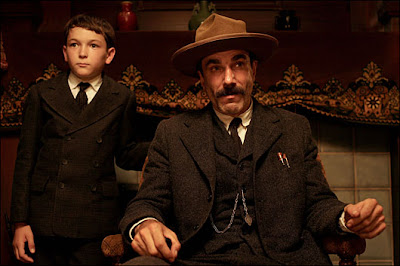
There Will Be Blood


Richard Schickel, the venerable film critic for Time, has written a review that seems to typify the nearly unanimous critical praise heaped upon There Will Be Blood. Schickel subtitles his review “An American Tragedy”, and though few, if any, have taken up this particular interpretive angle, the unrestrained awe that underlies the criticism is shared by many. Although it is not uncommon to see gushing praise from prominent critics in response to such an artfully crafted film, the profusion of superlatives that surround P.T. Anderson’s latest work seem, at least in some instances, to be exercises in extreme hyperbole. For example, David Denby wrote in the New Yorker that it was “as astounding in its emotional force and as haunting and mysterious as anything seen in American movies in recent years”, and Richard Schickel called it “one of the most wholly original American movies ever made.” Then there is Manohla Dargis, who concluded her review for the New York Times by saying “But the film is above all a consummate work of art, one that transcends the historically fraught context of its making, and its pleasures are unapologetically aesthetic. It reveals, excites, disturbs, provokes, but the window it opens is to human consciousness itself.” (emphasis mine)

Clearly, there is a subjective element to every piece of criticism, this one included. Yet I can't help but feel that the ravishing praise is as much a response to form as it is to content. So rare is the occurrence of film as art that when one aspires to the craftsmanship of a Stanley Kubrick or an Orson Welles there is a tendency to respond enthusiastically to the ambition itself, and when one achieves the level of masterful style that PT Anderson has in this picture, you can somehow understand the excitement it creates. However, to merely respond to form or style is to look only at the surface. What about what lies beneath? What I witnessed in There Will Be Blood was a remarkable refinement and progression of form, but a critical and nearly egregious regression of the human element that has, at least up to this point, characterized Anderson's entire oeuvre. Some may say this latter characterization, which I take to be a flaw, is precisely the point. Where is the humanity? Not here. Well, OK.


Yet what I find problematic is not Daniel Plainview’s extreme (and unexplained) misanthropy. It is the lack of depth or marginalization of every other character in the film. Daniel Day-Lewis' performance is Oscar-worthy and on par with some of the greatest in the history of cinema, but his channeling of Daniel Plainview gives us such an all-consuming character that nearly everyone else is pushed to the background. Paul Dano, as Eli Sunday, does a fine job trying to match the blistering intensity of Daniel Day-Lewis, but he is relegated to a secondary role, functioning mostly as an antagonist to the savage and brooding specter of Plainview. What we are given is, in effect, a character study: a nearly immaculate portrait (stylistically speaking) of a man so obsessed, so competitive, so full of mistrust, that he is in the process of losing his soul. He cannot relate to others and is therefore a prisoner in his own self-imposed isolation. The film is merciless in its' portrayal of relational disintegration, revealing an eroding sense of compassion that ultimately results in the complete absence of love, which, theologically speaking, means that at this point the picture becomes the very image of hell.

I use the phrase "theologically speaking" because the film supposedly contains a religious dimension, yet looking for anything of substance in the film's treatment of it is a nearly fruitless endeavor. In reality the film never delves deeply into matters of faith. Several times phrases such as "washed in the blood" or "the blood of the lamb" are used, yet any spiritual significance or metaphorical richness such explicitly Christian language may possibly point towards is never explored. Like the film's few scenes that contain real human concern and compassion, they are tantalizingly inserted here and there, leading you to think there will be a revelation of some gravitas, but there is not. They quietly disappear, with little evidence that they ever existed.

Why this is such a critical failure is that the film is commonly interpreted as a look at the intersection of business and faith, and the conflict they seem to engender when they become bedfellows. Part of the trouble lies in the fact that Eli Sunday is the film's embodiment of religion, but he is only a straw man, a caricature of fundamentalist Christianity, and a poor one at that. While he radiates a charisma and ambition similar to that of Plainview, his inner person, his beliefs, and whatever gospel he preaches, remain a mystery. Only at the end, when Plainview repays one brutal, extracted confession with another, does the film allow us a real glimpse at Eli. In some cases his distance and mysteriousness wouldn't be such an issue but P.T. Anderson's films have always been character-driven and emotionally raw and bare, and this film seems, at least formally, to continue that trend. Exactly how such an impoverished character can reveal anything about a life of faith or even the duplicity and hypocrisy that are its pitfalls is unclear.

This is a film that on nearly every level, whether it's the acting, directing, cinematography, editing, or music, screams "masterpiece!" and yet its' ability to develop its ideas and characters never matches its' epic structure. I'm not exactly sure what Manohla Dargis meant in her review by "it's pleasures are unapologetically aesthetic." I'm wondering if she's referring to being overwhelmed by Robert Elswit's gorgeous cinematography, or Johnny Greenwood's masterful score, or the riveting acting and go for the jugular directorial style that the film radiates. Maybe. Maybe not. Yet I'm not convinced the film opens a door to human consciousness. Yes, maybe Plainview embodies the worst qualities endemic to unfettered capitalism. Maybe his isolation is symbolic of a certain type of American arrogance. But the film's focus narrows to such an extent that I'm not sure it has anything substantial or insightful to say about oil, or business, or religion. What it does well is show one man's leap into the abyss: his growing emotional and spiritual deformity reveal him to be an anti-Christ of sorts, and there's more than a little irony in his echo of Christ's last words which bring this film to a close.

I think Richard Schickel is right, that there is something tragic at play here. But for the film to truly be a tragedy it would seem one would need to have some idea of what has been lost, but that's not the case here. There is more bravado than reflection. Please don't misunderstand, despite my criticism, I can't deny the film's excellence on many levels. It goes where many films never dare to go. There Will Be Blood is one of the most deeply unsettling and psychologically intense films I've ever seen. Yet it's the sort of film that is easy to admire but proves harder to love. I entered it with more anticipation than I've had for anything since The New World. This could have been one for the ages. The tragedy is that it turns out to be something less.


Wednesday, January 9, 2008

The Lives of Others

For over two decades Berlin was a city divided, its populace fractured not by ethnicity or religion but political ideology. It was a microcosm of the Cold War where the boundary between East and West was, quite literally, concrete, but still rather tenuous. In The Lives of Others, the remarkable debut film from writer and director Florian Henckel von Donnersmarck, we see only East Berlin, but the existence of the other side is something of which we are always acutely aware.

The film begins in the mid 1980’s, and ends after the fall of the Berlin Wall. We witness the efforts of the East German secret police, or the Stasi, as they attempt to monitor their citizens for any sign of dissent or disloyalty. Initially the primary face of the Stasi is Captain Gerd Wiesler (Ulrich Muhe), an intelligent, efficient, and perceptive man who is well-trained in the art of interrogation and whose suspicions are seemingly always aroused. With the permission of one of his superiors (and former classmate), he begins surveillance of a popular playwright, George Dreyman (Sebastian Koch), who is suspected by Wiesler of harboring Western sympathies. In reality Dreyman is supportive of the regime though he dislikes their harsh treatment of dissidents, such as his friend, a fellow writer, who has been blacklisted. He lives with his girlfriend Christa Maria (the beautiful Martina Gedick) whom is suspected by some of being a double agent, though this is a thought Dreyman himself cannot entertain. When his blacklisted friend commits suicide Dreyman decides to anonymously publish criticism of the regime’s methods in a Western paper, a decision that puts his literary career in jeoprady. Though he acts very cautiously, he never believes himself to be under surveillance, but much of the film takes place with Captain Wiesler listening to the events of Dreyman’s life. His loyalty to the regime comes into conflict with his inherent good nature. He begins to secretly display sympathy for Dreyman, which leads him down a potentially dangerous path.

Florian von Donnersmarck has crafted a film that is not only taut, suspenseful, and thoughtful, but also beautiful in every respect. From the photography to the well-paced narrative, to the moving score by Gabriel Yared, every part of the film contributes towards the excellence of the whole, but even if isolated and viewed separately each component manages to impress with its artfulness and craftsmanship. With The Lives of Others, von Donnersmarck has made, arguably, one of the best films of the past year and revealed himself to be a true talent. He has taken what on the surface could be a very traditional political thriller, and turned it into an engaging look at the divisions that lie in the heart. Many people in the film are wrestling with questions of ethics, but the consequences for doing the right thing are dire.

There is a piece of sheet music and a book that appear in the film that both bear the title Sonata for a Good Man. That could also function as a title for the film, since Wiesler and Dreyman are both good men. Everyone is tempted towards betrayal and disloyalty, but one form of subversion appears to be moral while the other does not. How does one differentiate between them? What is the impetus to do the right thing when that conviction may cost you everything?

Wiesler’s surveillance starts out detached, as state sanctioned voyeurism, but the inherent intimacy of the situation produces a conflicted conscience in the good man. One of the most profound things I think one can take away from this film is that, once you become involved in the lives of others, a funny thing happens. You start to care.

Wednesday, November 14, 2007

The Darjeeling Limited

The central focus and also the enduring obsession of nearly everything written about Wes Anderson and his films may be summarized in a four word phrase most commonly associated with E.B. White: the elements of style. While White’s slender volume was an impressive distillation of grammatical and compositional lucidity, personal profiles of Wes and critical reviews of his work are usually distillations themselves: accurate, if predictable, summaries of the Wes Anderson aesthetic, highly attentive to slow motion sequences, meticulous set design, French New Wave homage, and repeated use of British Invasion rock, to mention only a few of his most commented on techniques. Perhaps no director, at least no American director since Woody Allen, has been so identified with a particular style (though I would add that Woody’s stylistic versatility is often overlooked: who can honestly say that Stardust Memories or Match Point are cut from the same cloth as Annie Hall?) That style has, for an admittedly nominal audience, become as ubiquitous as the films themselves. For some, the quirky and peculiar seeds that began to blossom with Rushmore, and reached full-flowering in The Royal Tenenbaums, started to wilt once they appeared to be a permanent fixture rather than a temporary, though charming, calling card. So, with the messy, somewhat emotionally stilted, cartoonish, and childishly ornate Life Aquatic with Steve Zissou left to drift in the backwater, what does The Darjeeling Limited offer to Wes Anderson fans: a turn towards a different direction, or more of the same? The answer turns out to be: a bit of both.

Though sometimes described as a tale of three brothers on a spiritual quest in India, the film does not have the meditative quality that India might induce in a more mystically minded director (a la Terrence Malick). Even though the three brothers, Francis, Peter, and Jack, (Owen Wilson, Adrian Brody, and Jason Schwartzman respectively) are surrounded by holy shrines and temples, they quickly begin to bicker, initiating an air of frivolity and suspicion that lasts for most of the film. This is not to its detriment though: indeed, it results in most of the laughs. The humor is sharp and about as dry as an Indian summer, and carries, in typical Wes Anderson fashion, an undercurrent of melancholy and absurdity. In one early scene, Francis, Peter, and Jack sit in the dining car, traveling through an ancient land, seeking (at least in Francis’ eyes) a spiritual experience, but resort to trying each others controlled substances, as if they were filling up at a pharmaceutical buffet. The effect is comic, ironic, and more than a little sad: they begin to appear simultaneously as patently spoiled upper-crust basket cases and lovable fools.

Essentially, the The Darjeeling Limited plays out with a trio of alienated, fractured, but minimally hopeful and likeable western tourists trekking across a tropical landscape seeking some sort of reconciliation, however transitory it may be. The script has more life to it than did The Life Aquatic (an odd flop since Noah Baumbach was Wes’ co-writer) and each of the brothers, especially Francis and Peter, exhibit enough pathos to keep everything on track in the film’s awkward, and yes, predictable moments. Describing those moments in detail is unnecessary: anyone remotely familiar with his past work will spot them immediately. The difference here is that they punctuate, rather than define, the film.

The effect that the location has on the film may be debatable. For me, India is a canvass that very nearly paints itself, and here Anderson is armed with a dizzying array of spectacle, color, and sound with which to make his signature flourishes. There is usually something exotic or exaggerated about a Wes Anderson set, but the crucial difference here is that India is a naturally exotic environment, in contrast to the artificial though lavishly imagined interiors of the Tenenbaum house or Zissou’s ship. It is true that the train on which the brothers ride is impeccably and atypically stylish. Yet even if it is fantastic, it is not much more so than many of the natural locations. The inherent pageantry of India, though possibly romanticized through the western tourist’s eyes, tempers Anderson’s sometimes almost overwhelming stylishness. Perhaps for the first time since Rushmore, his characters appear to populate an actual environment.

Death (or is it life?) as a journey is an obvious though restrained theme throughout, and if this is a comedy it still harbors plenty of wounds. In a scene near the end of the film, Francis removes his bandages as he stares into a bathroom mirror. In that moment any semblance of a joke is also stripped away, and in a sense every kind of artifice is also removed, as the unveiled face of Owen Wilson manages to appear stark and somehow very real. It is a dangerous and beautiful moment, and yet it eschews tragedy and finds a way to live with its wounds. Like much of Hotel Chevalier, the short which precedes the film, this moment makes one ask: what would happen if Wes Anderson made an entire film in this manner? Watching The Darjeeling Limited one is tempted to draw parallels between Wes Anderson and his three protagonists. Both venture into new territory, unable to entirely leave the past behind, but manage, if only momentarily, to let go of some of the baggage.

Sunday, October 21, 2007

Update! There Will Be Blood

Although its' release date is two months away, PT Anderson's latest film is generating a lot of critical attention complete with all of its' ensuing hyperbole. Are reactions to the film that reference John Huston, Stanley Kubrick, Citizen Kane and its legendary performance by the venerable Orson Welles justified? Is this film, as one early reviewer described it, really the cinematic eqivalent of heroin? There's no way to know, but my hunch is we're in for a real treat. Oh, and did I mention that Mr. Johnny Greenwood, Radiohead guitarist, ondes martenot master, and BBC Composer in Residence, has written the score? Be still my heart.